Title:
Surveillance of colonic polyps: Are we getting it right?

Journal:
World Journal of Gastroenterology

Title:
Comparative monitoring of natural, hybrid and mechanical ventilation systems in urban canyons

Journal:
‍
Energy and Buildings

‍

Title:
Single-sided natural ventilation driven by wind pressure and temperature difference

Journal:
Energy and Buildings

Title:
Effect of window geometry on wind driven single sided ventilation through one opening‍

Journal:
Energy and Buildings‍

Source:
Volume 245

Title:
Evaluation of Interventions to Improve Ventilation in Households to Reduce Risk for transmission of Severe Acute Respiratory Syndrome Coronavirus 2

Journal:
Pathogens and Immunity

Title:
The impact of real-time carbon dioxide awareness on occupant behavior and ventilation rates in student dwellings

Journal:
Energy and Buildings‍

Title:
Effect of natural ventilation mode on thermal comfort and ventilation performance: Full-scale measurement

Journal:
Energy and Buildings

Source:
Volume 156

Title:
Effectiveness of Stack Ventilation in a Two-Storey House in Hot and Humid Climate

‍Journal:
‍
IOP Conference Series: Materials Science and Engineering

Title:
Correspondence between hair cortisol concentrations and 30-day integrated daily salivary and weekly urinary cortisol measures

Journal:
Psychoneuroendocrinology

Title:
The burden of Gastric Cancer and possible risk factors from 1990 to 2021, and projections until 2035: findings from the Global Burden of Disease Study 2021

Journal:
Biomarker Research

Title:
An evaluative system for the response of antibacterial therapy: Based on the morphological change of Helicobacter pylori and mucosal inflammation

Journal:
Pathology International

Title:
Clinical andlaboratory importance of detecting Helicobacter pylori coccoid forms for theselection of treatment

Journal:
Przegla̜d gastroenterologiczny (Gastroenterologyreview)

Title:
Systemic biomarkers in electronic cigarette users: implications for noninvasive assessment of vaping-associated pulmonary injuries

Journal:
ERJ Open Research

Title:
Evidence update on the respiratory health effects of vaping e-cigarettes: Asystematic review and meta-analysis

Journal:
Tobacco Induced Diseases

Title:
TNF-α Antagonism with Etanercept Decreases Glucose and Increases the Proportionof High Molecular Weight Adiponectin in Obese Subjects with Features of theMetabolic Syndrome

Journal:
The Journal of clinical endocrinology and metabolism.

Title:
Interleukin-1–Receptor Antagonist in Type 2 Diabetes Mellitus

Journal:
The New England Journal of Medicine

Title:
Associations between stress, resources, and hair cortisol concentration in teachers

Journal:
Psychoneuroendocrinology

Title:
Effort–reward-imbalance in healthy teachers is associated with higher LPS-stimulated production and lower glucocorticoid sensitivity of interleukin-6 in vitro

Journal:
Biological psychology (Biol Psychol)

Title:
Effort-reward imbalance, overcommitment, and cellular immune measures among white-collar employees

Journal:
Biological psychology (Biol Psychol)

Title:
Associations between the Psychophysiological Impacts of Teacher Occupational Stress and Stress Biomarkers: A Systematic Review

Journal:
Psychoneuroendocrinology

Title:
Coccoid H. pylori: A key driver of recurrent infections and a target for novel therapies

Journal:
Virulence

Title:
The effect of antibiotic resistance on Helicobacter pylori eradication efficacy: A systematic review and meta‐analysis

Journal:
Helicobacter

Title:
A human model of gastric carcinogenesis

Journal:
American Association for Cancer Research

Title:
Helicobacter pylori and gastric cancer: mechanisms and new perspectives

Journal:
Journal of Hematology & Oncology

Title:
Long-term follow-up of the incidence of Helicobacter pylori

Journal:
Clinical Microbiology and Infectious Diseases

Title:
Risk Factors and Incidence of Gastric Cancer After Detection of Helicobacter pylori Infection: A Large Cohort Study

Journal:
Gastroenterology

Title:
Global burden of cancer attributable to infections in 2018: a worldwide incidence analysis

Journal:
Lancet Global Health

Title:
Non‐urease producing Helicobacter pylori in chronic gastritis

Journal:
Internal Medicine Journal

Title:
Chronic inactive gastritis and coccoid Helicobacter pylori in patients treated for gastroesophageal reflux disease or with H pylori eradication therapy.

Journal:
American Journal of Clinical Pathology

Title:
Global Prevalence of Helicobacter pylori Infection and Incidence of Gastric Cancer Between 1980 and 2022

Journal:
Gastroenterology

Title:
Sleep Loss as a Factor to Induce Cellular and Molecular Inflammatory Variations

Journal:
Clinical and Developmental Immunology

Title:
Blood-Brain Barrier Disruption Induced by Chronic Sleep Loss: Low-Grade Inflammation May Be the Link

Journal:
‍
Journal of Immunology Research

Title:
Associations of Objectively Measured and Self-Reported Sleep Duration With Carotid Artery Intima Media Thickness Among Police Officers

Journal:
American Journal of Industrial Medicine

Title:
Adverse Effects of Modest Sleep Restriction on Sleepiness, Performance, and Inflammatory Cytokines

Journal:
The Journal of Clinical Endocrinology & Metabolism

Title:
Circadian interleukin-6 secretion and quantity and depth of sleep

Journal:
The Journal of Clinical Endocrinology & Metabolism

Title:
Adipose Tissue Hypoxia, Inflammation, and Fibrosis in Obese Insulin-Sensitive and Obese Insulin-Resistant Subjects

Journal:
The Journal of Clinical Endocrinology & Metabolism

Title:
Adipose Tissue Dysfunction as Determinant of Obesity-Associated Metabolic Complications

Journal:
International Journal of Molecular Sciences

Source:‍
PMID: 31085992

Title:
Polyester and Polyamides (Chapter 1)

Publisher:
Woodhead

Title:
‍
Realisation of polyester fabrics with low transmission for ultraviolet light

‍Journal:
‍
Coloration Technology

Title:
‍
Environment-friendly treatment to reduce photoyellowing and improve UV-blocking of wool

‍Journal:
‍
Polymer Degradation and Stability

Title:
Colorectal cancer incidence trends in younger versus older adults: an analysis of population-based cancer registry data

Journal:
The Lancet Oncology

Title:
England population mid-year estimate

Publisher:
Office of National Statistics (UK Government)

Source:
‍
Census

Title:
Bowel cancer screening standards data report 2023-24

Publisher:
Department of Health and Social Care (UK Government)

Title:
‍
A Review of Hereditary Colorectal Cancers

Publisher:
‍
StatPearls

Title:
A three-dimensional biomechanical analysis of the squat during varying stance widths

Journal
Medicine and Science in Sports and Exercise

Title:
‍
Physical Activity Interventions to Alleviate Depressive Symptoms in Children and Adolescents

‍Journal:
‍
JAMA Pediatrics

‍Source:
‍
PMID: 36595284

Title:
‍
Systematic Umbrella Review and Meta-Meta-Analysis: Effectiveness of Physical Activity in Improving Depression and Anxiety in Children and Adolescents

Journal:
‍
Journal of the American Academy of Child & Adolescent Psychiatry

Source:
‍
PMID: 40239946

Title:
‍
A Systematic Review and Meta-Analysis on the Effects of Exercise on the Endocannabinoid System

Journal:
‍
Cannabis and Cannabinoid Research

‍Source:
‍
PMID: 34870469

Publisher:
‍
National Institute for Health and Care Excellence

Title:
‍
Iron Absorption: Factors, Limitations, and Improvement Methods

‍Journal:
‍
ACS Omega

‍Source:
PMID: 35755397

Title:
‍
The Effects of Nutrition Knowledge on Food Label Use: A Review of the Literature

‍Journal:
‍
Appetite

‍Source:
‍
PMID: 26025086

Title:
‍
Age, an Important Sociodemographic Determinant of Factors Influencing Consumers’ Food Choices and Purchasing Habits: An English University Setting

‍Journal:
‍
Frontiers in Nutrition

‍Source:
‍
PMID: 35634371

Title:
‍
A systematic review, and meta-analyses, of the impact of health-related claims on dietary choices

‍Journal:
‍
International Association for the Study of Pain (PAIN)

‍Source:
‍
PMID: 38776178

Title:
‍
Who Reads Food Labels? Selected Predictors of Consumer Interest in Front-of-Package and Back-of-Package Labels during and after the Purchase‍

‍Journal:
‍
Nutrients

‍Source:
‍
PMID: 32867082

Title:
‍
Nutrition Knowledge, and Use and Understanding of Nutrition Information on Food Labels Among Consumers in the UK

‍Journal:
‍
Appetite

‍Source:
‍
PMID: 20546813

Government Department:
‍
Department of Health and Social Care‍

‍Government Department:
‍
Department of Health and Social Care

Title:
‍
Gender differences in perceived stress and coping among college students

‍Journal:
‍
PLoS ONE

‍Source:
‍
PMID: 34383790

Title:
‍
Global, regional and national burdens of depression in adolescents and young adults aged 10–24 years, from 1990 to 2019: findings from the 2019 Global Burden of Disease study

‍Journal:
‍
The British Journal of Psychiatry

‍Link:
‍
PMID: 38660761

Title:
‍
Global, regional and national burden of depressive disorders and attributable risk factors, from 1990 to 2021: results from the 2021 Global Burden of Disease study

‍Journal:
‍
The British Journal of Psychiatry

‍Link:
‍
PMID: 39809717

Title:
‍
Structure of major depressive disorder in adolescents and adults in the US general population

‍Journal:
‍
The British Journal of Psychiatry

‍Source:
‍
PMID: 22700082

Title:
‍
Lifetime prevalence and age-of-onset distributions of mental disorders in the World Health Organization's World Mental Health Survey Initiative

‍Journal:
‍
World Psychiatry

‍Source:
‍
PMID: 18188442

Title:
‍
Why do young men not seek help for affective mental health issues? A systematic review of perceived barriers and facilitators among adolescent boys and young men

‍Journal:
‍
European Child & Adolescent Psychiatry

‍Source:
‍
PMID: 39004687

Title:
‍
Review of the psychometric evidence of the perceived stress scale

Journal:
‍
Asian Nursing Research

‍Source:
‍
PMID: 25031113

Title:
‍
Estrogen, Stress, and Depression: Cognitive and Biological Interactions

‍Journal:
‍
Annual Review of Clinical Psychology

‍Source:
‍
PMID: 30786242‍

Title:
‍
Pubertal hormones and mental health problems in children and adolescents: a systematic review of population-based studies

‍Journal:
‍
eClinicalMedicine (The Lancet)

‍Source:
‍
PMID: 39403116

Title:
‍
Depressive Symptoms in Adolescence and Young Adulthood

Journal:
‍
JAMA Network Open

‍Source:
‍
PMID: 39141383

Title:
‍
Key Characteristics of Major Depressive Disorder Occurring in Childhood, Adolescence, Emerging Adulthood, Adulthood

Journal:
‍
Clinical Psychological Science

‍Source:
‍
PMID: 24273703

Title:
‍
The Social Context of Positive and Negative Affective States in Depressed Youth

‍Journal:
‍
Journal of Social and Clinical Psychology

Title:
‍
Grumpy or depressed? Disentangling typically developing adolescent mood from prodromal depression using experience sampling methods

‍Journal:
‍
Journal of Adolescence

Source:
‍
PMID: 33607507

Title:
‍
Global, Regional, and National Epidemiology of Depression in Working-Age Individuals, 1990–2019

‍Journal:
‍
Depression and Anxiety

‍Source:
‍
PMID: 40226639

Title:
‍
Key Characteristics of Major Depressive Disorder Occurring in Childhood, Adolescence, Emerging Adulthood, Adulthood

‍Journal:
‍
Clinical Psychological Science

‍Source:
‍
PMID: 24273703

Title:
‍
Adolescent and adult differences in major depression symptom profiles

‍Journal:
‍
Journal of Affective Disorders

‍Source:
‍
PMID: 30243197

Title:
‍
environmental impact of textile fibers – what we know and what we don’t know

Title:
‍
Comparative Analysis of Thermal Comfort and Antimicrobial Properties of Base Fabrics for Smart Socks as Personal Protective Equipment (PPE)

‍Journal:
‍
Materials

Title:
‍
Protection against ultraviolet radiation by commercial summer clothing: need for standardised testing and labelling

‍Journal:
‍
BMC Dermatology

Title:
‍
Measurement of the dynamic moisture buffering potential of fabrics

‍Journal:
‍
Textile Research Journal

Title:
‍
Textiles — Physiological effects — Measurement of thermal and water-vapour resistance under steady-state conditions (sweating guarded-hotplate test)

‍Publisher:
‍
International Standards Organisation (ISO)

‍Standard Number:
‍ISO 11092:2014

Title:
‍
Alterations in Three-dimensional Knee Kinematics and Kinetics during Neutral, Squeeze and Outward Squat

‍Journal:
‍
Journal of Human Kinetics

‍Source:
PMID: 24511341

Title:
‍
A biomechanical comparison of back and front squats in healthy trained individuals

Journal:
‍
The Journal of Strength and Conditioning Research (JSCR)

‍Source:
PMID: 19002072

Title:
Dynamic load at baseline can predict radiographic disease progression in medial compartment knee osteoarthritis

Journal:
Annals of the Rheumatic Diseases

Title:
‍
Effects of Foot Position during Squatting on the Quadriceps Femoris: An Electromyographic Study

‍Journal:
‍
The International Journal of Exercise Science (IJES)

‍Source:
PMID: 27293497

Title:
‍
The effect of knee and foot position on the electromyographical activity of the superficial quadriceps

Journal:
‍
Journal of Orthopaedic & Sports Physical Therapy

‍Source:
PMID: 7550299

Title:
‍
Effect of range of motion in heavy load squatting on muscle and tendon adaptations

‍Journal:
‍
European Journal of Applied Physiology

Title:
‍
Knee biomechanics of the dynamic squat exercise

‍Journal:
‍
Medicine & Science in Sports & Exercise

‍Source:
PMID: 11194098

Title:
‍
Impact of the deep squat on articular knee joint structures, friend or enemy? A scoping review

‍Journal:
‍
Frontiers in Sports and Active Living

‍Source:
PMID: 39640505

Title:
‍
The effect of back squat depth on the EMG activity of 4 superficial hip and thigh muscles

‍Journal
‍
The Journal of Strength and Conditioning Research (JSCR)

Title:
‍
The effect of stance width on the electromyographical activity of eight superficial thigh muscles during back squat with different bar loads

‍Journal:
‍
The Journal of Strength and Conditioning Research (JSCR)

‍Source:
PMID: 19130646

Title
‍
Effects of technique variations on knee biomechanics during the squat and leg press

‍Journal
‍
Medicine & Science in Sports & Exercise

Title:
‍
Stance width and bar load effects on leg muscle activity during the parallel squat

‍Journal:
‍
Medicine & Science in Sports & Exercise

‍Source:
PMID: 10188748

Title
‍
The Limitations of Anterior Knee Displacement during Different Barbell Squat Techniques: A Comprehensive Review

‍Journal
‍
Journal of Clinical Medicine

Title:
‍
Quantifying the movement and the influence of load in the back squat exercise

‍Journal:
‍
The Journal of Strength and Conditioning Research (JSCR)

‍Source:
PMID: 20508473

Title:
‍
A biomechanical comparison of the traditional squat, powerlifting squat, and box squat

‍Journal:
‍
The Journal of Strength and Conditioning Research (JSCR)

Title:
‍
How to squat? Effects of various stance widths, foot placement angles and level of experience on knee, hip and trunk motion and loading

‍Journal:
‍
The Journal of Strength and Conditioning Research (JSCR)

‍Source:
PMID:30026952

Title
‍
Effect of knee position on hip and knee torques during the barbell squat

Journal
‍
The Journal of Strength and Conditioning Research (JSCR)

Title:
‍
Kinematics of the Trunk and the Lower Extremities During Restricted and Unrestricted Squats

‍Journal:
‍
The Journal of Strength and Conditioning Research (JSCR)

‍Source:
PMID: 22990570

Title:
‍
A Biomechanical Review of the Squat Exercise: Implications for Clinical Practice

‍Journal:
‍
International Journal of Sports Physical Therapy (IJSPT)

Title:
‍
Comparison of Lumbar Spine Loads During Back and Front Squats

Title:
‍
New In Vivo Measurements of Pressures in the Intervertebral Disc in Daily Life

‍Journal:
‍
Spine

Title
‍
Changes in lumbar lordosis modify the role of the extensor muscles.

‍Journal
‍
Clinical Biomechanics

Title
‍
Comparison of intradiscal pressures and spinal fixator loads for different body positions and exercises

‍Journal
Ergonomics

Title
‍
Activation of back and lower limb muscles during squat exercises with different trunk flexion

‍Journal
‍
Journal of Physical Therapy Science

‍Source
‍
PMID: 28174462

Title
Indices of Deprivation 2019 local authority dashboard

Title
People living in deprived neighbourhoods

Title:
Racial and ethnic disparities in colorectal cancer incidence and mortality

Journal:
Advances in Cancer Research

Title:
Inequalities in colorectal cancer diagnosis by ethnic group: a population-level study in the English National Health Service

Journal:
BMJ Open Gastroenterology

Title:
National Diet and Nutrition Survey Rolling programme Years 9 to 11 (2016/2017 to 2018/2019)

Title:
Population attributable risk for colorectal and breast cancer in England, Wales, Scotland, Northern Ireland, and the United Kingdom

Journal:
AMRC Open Research

Title:
Global burden, trends, and risk factors of early-onset and late-onset colorectal cancer from 1990 to 2021, with projections to 2040: a population-based study

Journal:
BMC Gastroenterology

Title:
Global burden of colon and rectal cancer and attributable risk factors in 204 countries and territories from 1990 to 2021

Journal:
BMC Gastroenterology

Title:
Trends in UK meat consumption: analysis of data from years 1–11 (2008–09 to 2018–19) of the National Diet and Nutrition Survey rolling programme

Journal:
Lacent Planet Health

Title:
Cancer registrations statistics, England

Title:
Cancer registration statistics, England

Title:
The global, regional, and national burden of colorectal cancer and its attributable risk factors in 195 countries and territories, 1990-2017: a systematic analysis for the Global Burden of Disease Study 2017.

Journal:
The Lancet

Fabric Properties: Wool, Cotton and Polyester

Summary
● Basic properties of fabric important to consumers include insulation, airflow, moisture handling, and UV protection.
● Wool often offers the best insulation and moisture control, while polyester excels in breathability.
● Wool and polyester provide stronger UV protection, while cotton often offers lower protection levels.
● Polyester is supreme for airflow, cotton is moderate, while wool varies significantly with fabric structure.
● Extending garment lifespan greatly reduces environmental impact by lowering "emissions per use".

Introduction

Common fabrics such as wool, cotton, and polyester each have unique properties shaped by how the yarn/fibre is architectured (e.g., weave pattern, porosity and thread density).

Other physical characteristics are more familiar to consumers, e.g., grams per square metre (g/m²), better known as GSM.

Understanding these basic parameters helps consumers and designers make better-informed choices.

This article examines five functional characteristics: warmth, ultraviolet protection factor (UPF), moisture management, breathability, and sustainability.

It also considers the environmental impact of wool, cotton, and polyester through what is known as the life cycle assessment (LCA), quantifying the environmental trade-offs between natural and synthetic fibres.

By comparing these materials, the article provides a clear guide to selecting fabrics based on functionality and sustainability.

1. Warmth

Figure 1 shows the thermal resistance of wool, cotton and polyester during stationary conditions. <tt>2001</tt>

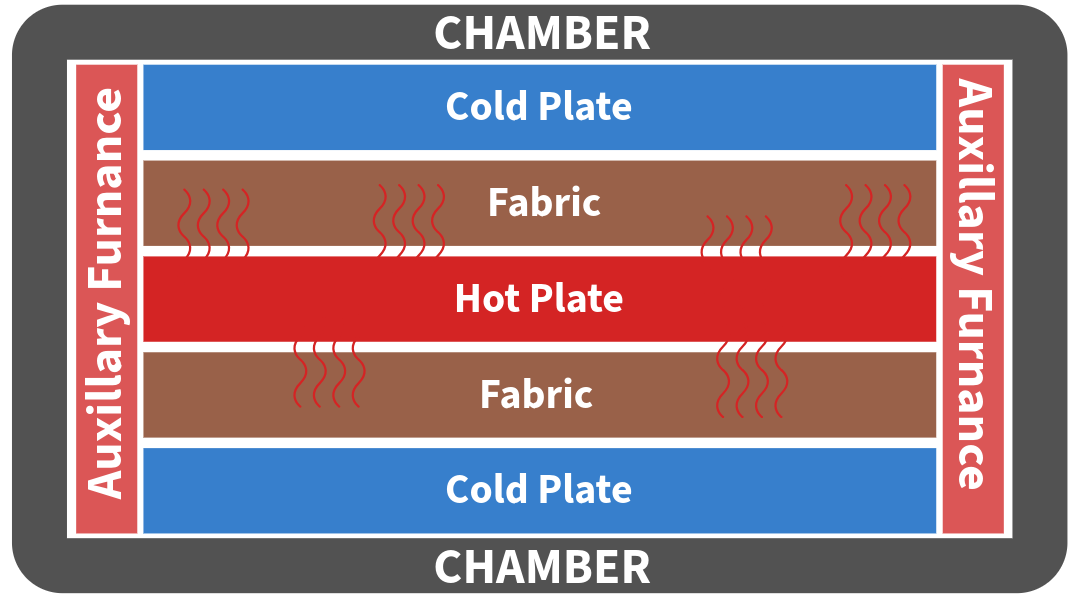
For context, the warmth of a fabric is often referred to, in textile science, as 'thermal resistance' (Rct) and reflects how well a material resists heat transfer (or heat loss) to the ambient air.

Researchers measure this thermal resistance of fabrics using a setup shown in figure 2, known as a guarded-hotplate test. <tt>2000</tt>

The test is principled as follows: a fabric with higher insulation properties (or thermal resistance) will lose less heat emitted from the hot plate it surrounds, so less electrical power is therefore required to maintain a constant plate temperature (e.g., 35°C), despite a lower (and fixed) ambient temperature (e.g., 20°C).

Despite very similar mass (grams/meter²), wool showed 105% higher thermal resistance than cotton and 69% higher thermal resistance than polyester.

Researchers largely attribute the enhanced thermal resistance of wool to its natural thickness, which is mostly made up of air pockets, trapped in the labyrinth of wool fibres.

These air pockets absorb and trap the natural warmth emitted from the human body.

Wool fibres also naturally have repulsive electrostatic properties which create fibres that crimp, rather than the linear and malleable behaviour seen in polyester fibres, which form a low-density, air-filled matrix that substantially contributes to thermal insulation.

Custom Table
Heat Insulation Properties
Mass
(g/m²)
Mean hickness
(mm)
Thermal resistance (Rct)
(m²·K·W⁻¹)
Wool 150 1.162 0.0252
Cotton 143 1.033 0.0123
Polyester (PET) 150 1.020 0.0149
Title:
Measurement of the dynamic moisture buffering potential of fabrics
Journal:
Textile Research Journal
Link:
Volume 89, Issue 5

2. Ultraviolet Protection Factor (UPF)

Sunscreens and lotions are synonymous with ultraviolet (UV) protection. But the fabric of worn clothing can provide just as much, if not more, UV protection than sunscreen lotion alone.

A 2001 study published in BMC Dermatology involved transmitting UV radiation (across the 290–400 nm range) directly onto samples taken from a total of 236 tested fabrics, with the quantity of UV passing through each sample being measured. <tt>2002</tt>

Figure 3 shows the overwhelming majority of <u>wool and polyester fabrics achieved a UPF rating of 50+</u>, in stark contrast to cotton fabrics, in which <u>over 75% of samples achieved an UPF of under 30</u>.

Interestingly, due to the molecular properties, many of the wool and polyester samples achieved high UPF values. Wool fibres are made of keratin (~95% - 99%), a protein that contains aromatic amino acids (tryptophan, tyrosine, and phenylalanine) that absorb UV light, especially in the UVB and UVA range. <tt>2005</tt>

Similarly, polyester, being composed of a chain of terephthalate groups attached to ethylene groups, is believed to have a UV absorption effect, specifically due to the benzene ring within the terephthalate group. <tt>2006</tt>

However, not all wool and polyester samples blocked high doses of UV radiation in the study. This suggests other fabric parameters, such as fabric construction, including weave tightness and fabric thickness, also play a significant role. <tt>2007</tt>

A common metric used to quantify fibre density both in commercial retail of clothing and in textile science is grams per square metre (g/m²), marketed as GSM. This reflects the amount of fabric in one square metre of a given fabric.

A higher GSM often correlates with higher UPF protection but could also diminish breathability.

Custom Table
Fabric Ultraviolet Protection Factor (UPF)
Ultraviolet Protective Factor (UPF) Cotton
Fabrics
Wool
Fabics
Polyester
Fabrics
Blended
Fabrics
UPF 0+ (<5) 7.1% 0% 2.3% 0%
UPF 5+ 21.4% 0% 0% 0%
UPF 10+ 14.3% 0% 0% 3.8%
UPF 15+ 14.3% 0% 4.7% 5.8%
UPF 20+ 21.4% 0% 0% 3.8%
UPF 25+ 0% 0% 2.3% 7.7%
UPF 30+ 0% 0% 2.3% 5.8%
UPF 35+ 0% 0% 0% 7.7%
UPF 40+ 7.1% 9.1% 4.7% 5.8%
UPF 45+ 0% 18.2% 7.0% 13.5%
UPF 50+ 14.3% 72.7% 76.7% 46.2%
Title:
Protection against ultraviolet radiation by commercial summer clothing: need for standardised testing and labelling
Journal:
BMC Dermatology
Link:
PMID: 11710968

3.Moisture Management

Figure 4 shows the percentage of moisture vapour absorbed by wool, cotton and polyester fabrics at two humidity levels (45% and 85%). <tt>2001<tt>

In both humidity settings, wool demonstrates superior moisture regain (i.e., quantity of absorbed moisture vapour), cotton is intermediate, and polyester absorbs very little moisture.

The study determined these findings by calculating and measuring the energy released when water molecules form bonds with fibres of fabric, reflected by "transient heat peak area (kJ/m²)".

3.1 The Science in Context

During physical exertion, the skin-side microclimate experiences frequent spikes in humidity due to perspiration (sweating).

When activity slows, so does perspiration, and consequently humidity decreases.

Fabrics absorb moisture vapour and, in doing so, release heat from the chemical bonds as the fabric interacts with water molecules.

Conversely, heat energy is taken in during the opposite process, the drying (desorption) of fabric, as moisture vapour is released; this process stems from the breaking of chemical bonds between water molecules and the fibres of the fabric.

One shortcoming is the authors of this study did not quantify how well the fabric dries (desorbs) between wool, cotton and polyester, i.e., how well those fabrics dry during changes in humidity level.  

Such results would have provided a more whole understanding of how a fabric would perform in managing moisture during extended periods of physical activity.

Custom Table
Fabric Moisture Regain
Material Mass
(g/m²)
Moisture Regain
(45% RH)
Moisture Regain
(85% RH)
Transient Heat Peak Area
(kJ/m²)
Relative Dynamic Buffering
(vs Wool)
Water Vapor Resistance, Ret
(m²·Pa/W)
Cotton 143.00 5.6% 13.0% 6.93 −70% 6.2
Wool 150.00 10.6% 21.0% 9.90 100% 6.3
Polyester 150.00 0.5% 0.8% 0.57 −6% 6.1
Title:
Measurement of the dynamic moisture buffering potential of fabrics
Journal
Textile Research Journal
Link:
Volume 89, Issue 5

4. Breathability

The breathability of a fabric is often referred to as air permeability in textile science. And one of the parameters which determine air permeability is porosity, i.e., the quality of pores in the weave of the fabric architecture. <tt>2003</tt>

A recent 2025 study directly compared the air permeability of wool, cotton and polyester fabrics in each in the form of various fabric constructions (single jersey, terry knit, rib knit, mesh knit).

Polyester, being very malleable and linear, generally achieved higher air permeability than cotton and wool (besides the uncommon mesh-fabric construction), both of which tend to be thicker and crumple on themselves as they loop and, consequently, diminish the size of adjacent air channels.

Jumpers are a great example for explaining how fabric structures can affect an individual’s microclimate via fabric breathability and, consequently, suitability for various weather conditions.

Light crewneck and V-neck jumpers typically use a cotton fabric in conjunction with a <u>jersey knit construction</u>. This creates a lightweight and thinner fabric, used for mild weather or indoor settings.

In contrast, it is common for sweatshirts to use cotton fabric in conjunction with a <u>terry knit construction</u>, characterised and observed in this study by low air permeability.

Although likely a thick and heavier fabric, this construction is favourable since it has traditionally been used to give warmth in colder weather.

For activewear, a fabric construction with high air breathability is preferred, like <u>polyester</u>.

Figure 5 shows polyester single jersey was found to be 198.75% as air permeable as cotton single jersey fabric construction. This is one parameter which makes polytester preferred in sport activewear.

However, polyester often comes with poorer moisture management. Hence, a blended fabric material is increasingly sought by manufacturers and consumers.

It is also important to mention, as did the researchers, other parameters, such as thickness, loop length, porosity, and density, also contribute to the air permeability of fabrics.

Custom Table
Fabric Air Permeability
cm3/cm2/s
Single Jersey Terry Knit Rib Knit Mesh Knit
Cotton 95.7 15.6 109.6 622.8
Wool 85.5 223.5 137.5 -
Polyester 190.2 114.8 229.8 151.5
Title:
Comparative Analysis of Thermal Comfort and Antimicrobial Properties of Base Fabrics for Smart Socks as Personal Protective Equipment (PPE)
Journal:
Materials
Link:
Volume 18, Issue 5

5. Sustainability

One of the methods researchers use to assess the sustainability of a material is known as the life cycle assessment (LCA).

This assessment evaluates a product’s total environmental impact from “cradle to grave”, including extraction of raw materials, production, processing, consumer usage, and end of life (disposal or recycling).

A report published by The Swedish Foundation for Strategic Environmental Research (MISTRA) quantified the greenhouse gas emission (GHGE), measured in CO₂ equivalent (kg) per kg of fibre, for the life cycle of wool, cotton and polyester, shown in figure 7. <tt>2004</tt>

Wool happened to have the highest greenhouse gas emission (GHGE), with an average of 16.8 CO₂ equivalents (kg) per kg of fibre. Although 75% was attributed to the methane gas, which has a global warming potential (GWP) 28 times that of carbon dioxide (CO₂), released as a result of enteric fermentation in sheep.

The production of cotton produces much lower greenhouse gas emissions (GHGE) compared to wool. Although being a plant fibre, it requires 860% more water than wool and 4700% more water than polyester for production.

Surprisingly, the production of cotton and polyester, on average, involves comparable levels of greenhouse gas emission (GHGE).

However, greenhouse gas emissions (GHGE) do not include the ecological costs of the large volume of unrecycled polyester fibres that seep into and diminish the environment and habitats (e.g., marine life).

One striking finding for the report by MISTRA was how much greenhouse gas emission (GHGE) can be reduced by extending the lifespan of a single garment, known as the impact per wear.

If a consumer wears a cotton or polyester t-shirt 60 times instead of 30 times, they can halve the greenhouse gas emission (GHGE) by amortising the environmental load over many uses.

Custom Table
Greenhouse Gas Emission (GHGE)
CO2 Equivalent (kg) per kg of Fibre
Material Low End Average High End
Wool -26.00 16.8 36.2
Cotton -0.90 2.2 9.3
Polyester (PET) 1.70 3.3 4.5
Title:
Environmental impact of textile fibers – what we know and what we don’t know
Journal
Textile Research Journal
Link:
Mistra Future Fashion
Custom Table
Water Depletion and Usage
(1,000 litres /kg of Fibre)
Material Low End Average High End
Wool 0.04 0.5 1.2
Cotton 0.0 4.8 29.0
Polyester (PET) 0.1 0.1 0.2
Title:
Environmental impact of textile fibers – what we know and what we don’t know
Journal
Textile Research Journal
Link:
Mistra Future Fashion

Conclusion

In conclusion, wool, cotton, and polyester each offer distinct strengths and limitations across key fabric properties.

Wool excels in warmth and moisture management, cotton provides comfort and moderate performance, while polyester stands out in breathability and durability.

However, no single material is superior in all aspects, and trade-offs are inevitable.

Sustainability further complicates these choices, as environmental impacts vary depending on production and usage.

Ultimately, selecting the right fabric depends on balancing performance needs with environmental considerations.

By understanding these factors, consumers and designers can make more informed, responsible decisions when choosing materials for different purposes and conditions.