Optimising Natural Ventilation in Your Home


Introduction
Natural ventilation remains one of the simplest ways to improve indoor comfort, reduce heat buildup, and limit reliance on mechanical cooling.
In homes, airflow is shaped by several interacting factors, including window placement, wind direction, room layout, and occupant behaviour.
This article examines five practical ventilation strategies: stack ventilation, cross ventilation, pulse ventilation, single ventilation, and wind-induced ventilation.
Drawing on field studies and experimental data, it explains how each method affects temperature, humidity, CO₂ concentration, and thermal comfort.
Together, these approaches show that small and strategic actions, such as opening selected windows, can meaningfully improve indoor air quality and comfort.

1. Stack Ventilation
Living in a multi-storey house offers distinct microclimatic advantages: greater control over airflow and, by extension, natural ventilation.
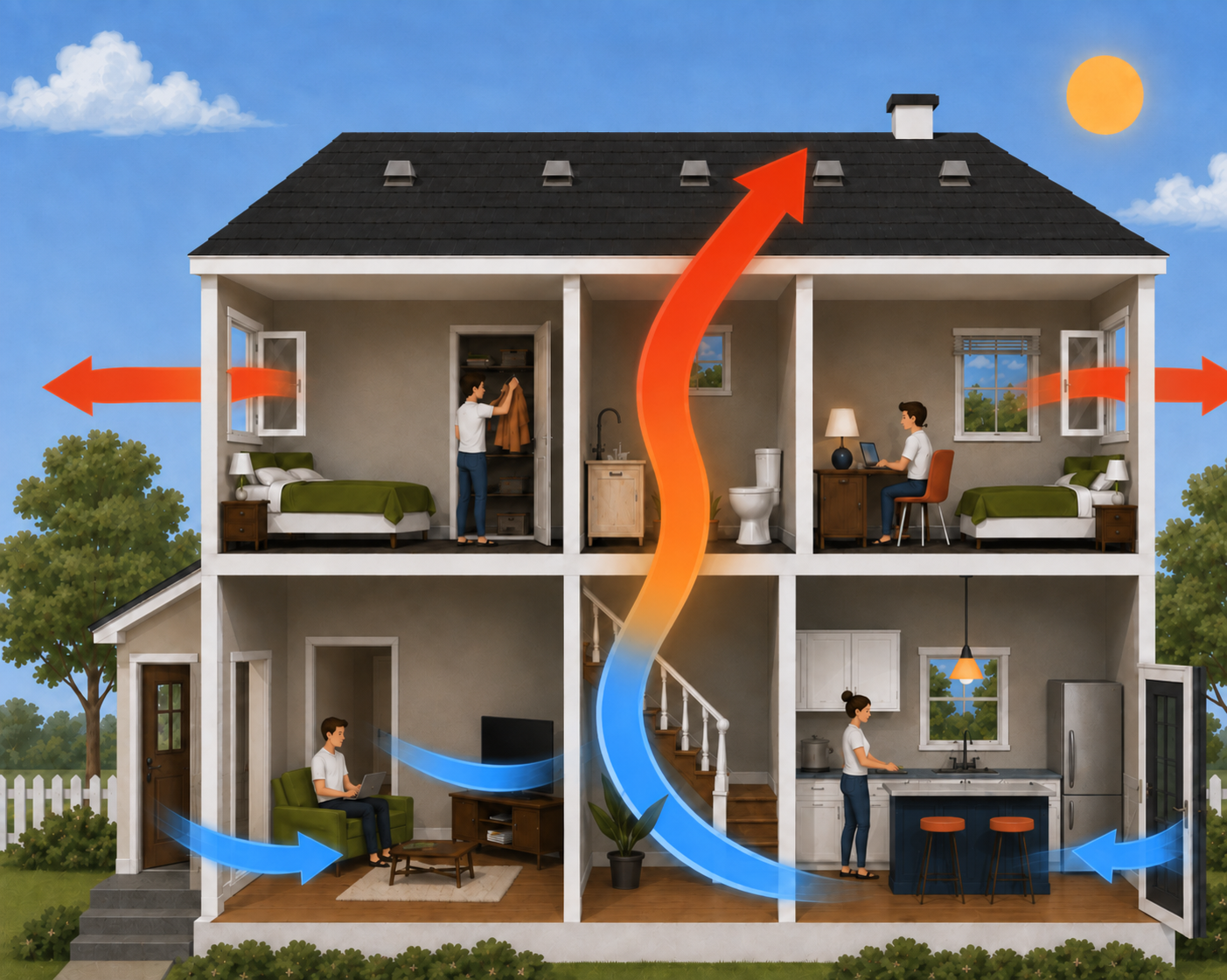
This is based on the idea of stack ventilation, whereby warm air rises through the building and exits at higher-level openings, such as a bedroom window or balcony door, while cooler air settles lower, creating a stratification of temperature.
This ventilation method was demonstrated in a 2018 field study comparing two 167 m² houses in Bangkok, Thailand, one integrated with methods of stack ventilation and one without.<tt>2200</tt>
The field study incorporated an operable window in the garage door to facilitate air inflow into the house, along with openings or slots above a second-floor bedroom door and five rooftop vents to facilitate air outflow.
Multiple sensors measuring temperature, humidity and air velocity were placed across both floors of each house for the duration of the study, 3 consecutive days.
Findings suggest the stack ventilation-integrated home was 0.6°C cooler on the ground floor (hallway) and 0.7°C cooler on the second floor (stair hall). The humidity was also 9% lower on the ground floor (hallway) and 5.6% lower on the second floor (stair hall).
Although the results of this study seem modest, they are impressive considering the effort required to apply and will likely have a noticeable change in comfort levels, particularly regarding humidity.

2. Cross Ventilation
Cross ventilation typically describes the movement of air through two openings, one inlet, such as a door, window, or vent, and exits through another outlet, typically on the same level.
The inlet and outlet are determined by the wind-induced pressure distribution around the building. If wind-induced pressure is greater on one side, that side will likely be the inlet, while other openings, around which wind-induced pressure is lower, will likely facilitate the outlet for ventilation.
This pressure distribution around each opening is influenced by technical parameters (e.g., external wind speed and direction, façade orientation, and the geometry of the openings), which are outside the scope of this article.
However, this cross ventilation is considered more effective in stimulating and maintaining ventilation in comparison to the more common method of <u>single-sided ventilation</u>, whereby one opening is used as both the inlet and outlet.
The comparison between the two ventilation methods was quantified in a 2017 case study, where researchers measured the temperature, humidity and airflow speed in two identical high-rise apartments of Brisbane, Australia.<tt>2201</tt>
Over two days, one apartment kept both the southern and northern balcony doors open to stimulate <u>cross-ventilation</u>, while only the southern balcony doors were kept open in the second apartment to stimulate only <u>single-sided ventilation</u>.
On average, the apartment using cross ventilation was more than 1°C cooler.
Despite no meaningful difference in humidity inside either apartment, based on widely used predictive models, <thermal comfort</u> was calculated to be adequate in the apartment employing <u>cross-ventilation</u> for 70% of the study duration.
By contrast, thermal comfort was adequate for only 1% of the study period in the apartment relying on single-sided ventilation.
The higher thermal comfort score in the apartment employing cross ventilation is likely explained by greater circulation (less stagnant air), which during humidity conditions is known to help enhance cooling by evaporating perspiration (sweat) from the skin.

3. Pulse Ventilation
Pulse ventilation refers to allowing short bursts of airflow to replace stale indoor air with fresh outdoor air, rather than ventilating continuously.
The main advantage here is that it doesn't take long to replace an entire volume of stale indoor air with airflow from outside.
Pulse ventilation can be preferred for some demographics, since opening a window can introduce noise, allergens, or a security or child risk.
Figure 5 shows the air change per hour (ACH), i.e., the quantity of indoor volume of air replaced in one hour; in the case of the sourced literature, it is based on the carbon dioxide (CO₂) exhalation of occupants during the nighttime.
This data was collected from CO₂ concentration measurements across 60 student dwellings in two countries, between 2019 and 2022. <tt>2203</tt>
The findings formed part of a study published in 2024 in which researchers investigated how awareness of indoor CO₂ concentrations influenced occupants’ decisions about when and how to ventilate their homes.
In Week 1, the median estimated bedroom ventilation rate in apartments was 0.30 air changes per hour, compared with 0.21 air changes per hour in single-family homes.
So although apartments, in this study, ventilated proportionally more and sooner—likely because they contain a smaller volume of air to replace—single-family homes are not far behind.
In fact, during the second week, when occupants were allowed visual access to real-time CO₂ concentration data for their homes, single-family homes appeared to be ventilated better, at least in part because access to real-time readings encouraged occupants to take steps to better ventilate their homes, such as opening the window for less than 5 minutes several times a day, which participants ultimately described as 'effective'.
The most practical takeaway from this study could be opening a window for only one hour ventilates a <u>worthwhile and significant</u> proportion of a home, despite its size.
4. Single-Sided Ventilation
Although single-sided ventilation may not be as effective as cross-ventilation, there are steps one can take to minimise this difference.
A simple mechanical fan is a good starting point, as it helps move air that would otherwise remain stagnant.
An extraction fan, ideally located across an opening, can help maximise and maintain consistent ventilation but requires retrofitting if it is not already installed.
However, after simply opening a window, many interventions give diminishing returns in terms of air change per hour (ACH).
Figure 6 presents data from an interventional study in which a tracer gas was introduced into three apartments in the urban city of Athens, Greece.
Researchers measured the concentration changes of these gases under several ventilation methods, including natural ventilation (single-seeded ventilation and cross ventilation) and mechanical ventilation (i.e., with the addition of a supply/exhaust fan(s)). <tt>2208</tt>
The addition of a supply/exhaust fan improved air change per hour (ACH) by an additional 130% - 200%. Which means it could have taken half the time to replace the existing air in the apartment with the addition of a supply/exhaust fan.
Interestingly, in the context of cross ventilation, on the days in which wind speed was higher, using a supple/exhaust fan did not improve air change per hour (ACH); in fact, this intervention gave inferior results compared to simply opening two winds across each other in the apartment.
The study gives interesting insights into which interventions help improve ventilation and, perhaps more importantly, when those interventions are most useful.
This has practical implications for reducing unnecessary energy consumption and avoiding overuse, thereby supporting more sustainable indoor air quality management.
5. Wind-Induced Ventilation
The weather and, more specifically, the wind profile on a particular day can influence the degree to which natural ventilation is effective.
This is one of the greatest criticisms of natural ventilation: the inconsistency and unpredictability.
Architects typically consider local weather patterns and how these patterns interact with the protrusions, recesses, and corners of a building façade, as well as which window configuration would optimise natural ventilation.
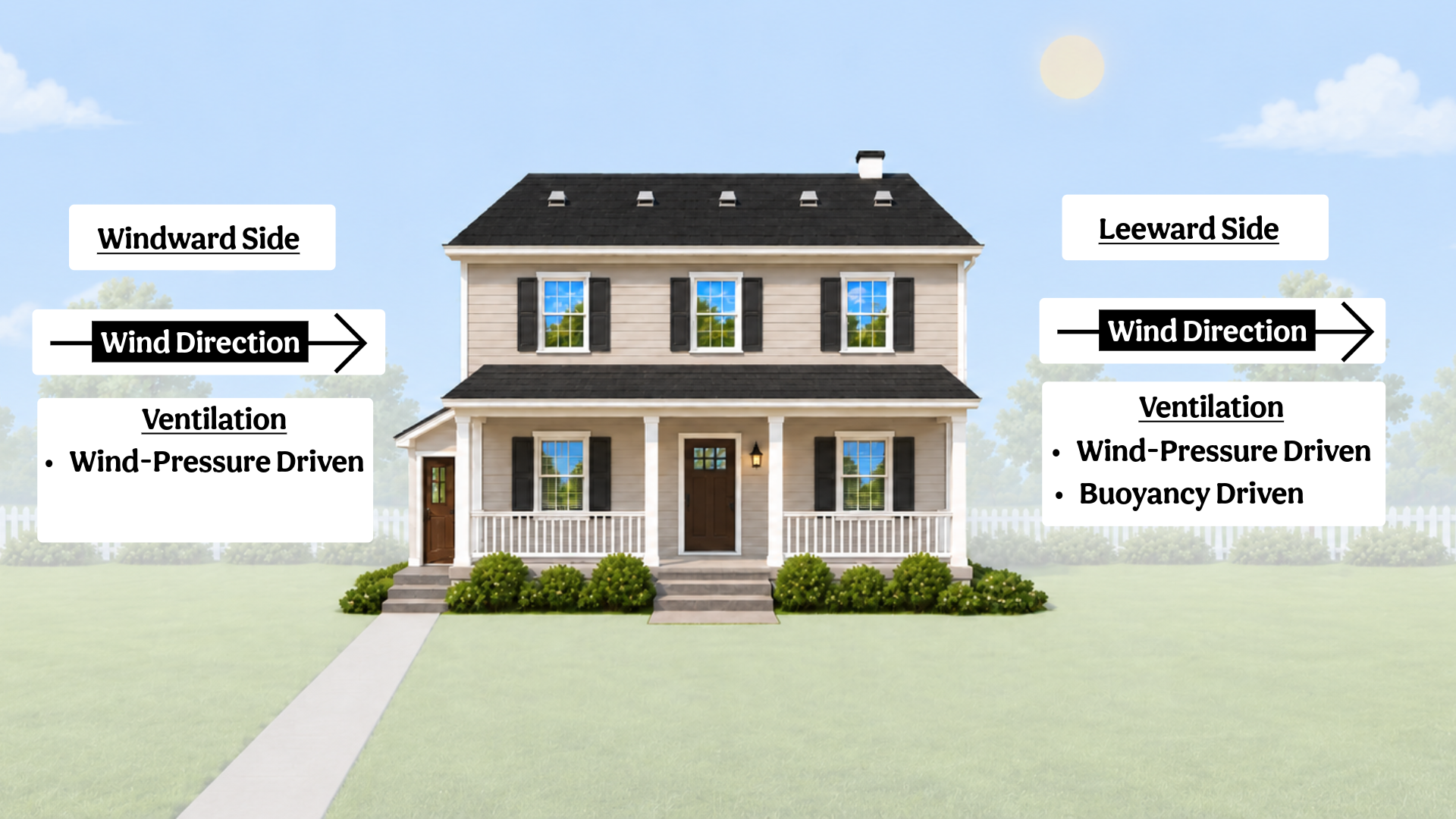
A 2006 study attempted to assess how wind directions (windward, leeward and parallel) relative to a particular facade of a house at various wind speeds (1 m/s, 5 m/s and 5 m/s) affect the ventilation efficiency.<tt>2206</tt>
At lower wind speeds, buoyancy-driven ventilation (caused by indoor–outdoor temperature differences) became more important. This means that the airflow through the window was dependent on the temperature difference between the outdoor/indoor environment.
The bigger the temperature difference, the more airflow until the difference eventually would equalise. This effect was particularly the case when the wind flowed parallel to the window plane or when the opening was on the leeward side of the building.
Wind direction towards a window opening was generally most favourable for natural ventilation. <tt>2206</tt>
However, in the case of parallel wind direction relative to the building facade, a side-hung window was observed to offer optimal airflow into an indoor space relative to other window configurations. <tt>2205</tt>
In fact, a side-hung window configuration allows 3.97x the airflow into a room compared to a sash window configuration, acting as a scoop and diverting airflow into a room.
The nuances of how wind profiles influence natural ventilation are fascinating but beyond the scope of this article. The simplest and most practical takeaway is perhaps to open the window you feel comfortable opening, and in the vast majority of cases, this will be favourable to natural ventilation.
Conclusion
Natural ventilation is not a single technique but a collection of strategies that work differently depending on building design, weather conditions, and how occupants use openings.
Stack and cross-ventilation can improve airflow and cooling, while pulse and single-sided ventilation offer practical alternatives when continuous ventilation is inconvenient or limited.
Wind conditions add variability, but they also create opportunities to enhance airflow through suitable window choices.
Across the studies discussed, the evidence supports a clear practical message: opening windows or doors strategically can reduce heat, humidity, and indoor CO₂ while lowering dependence on energy-intensive mechanical systems.